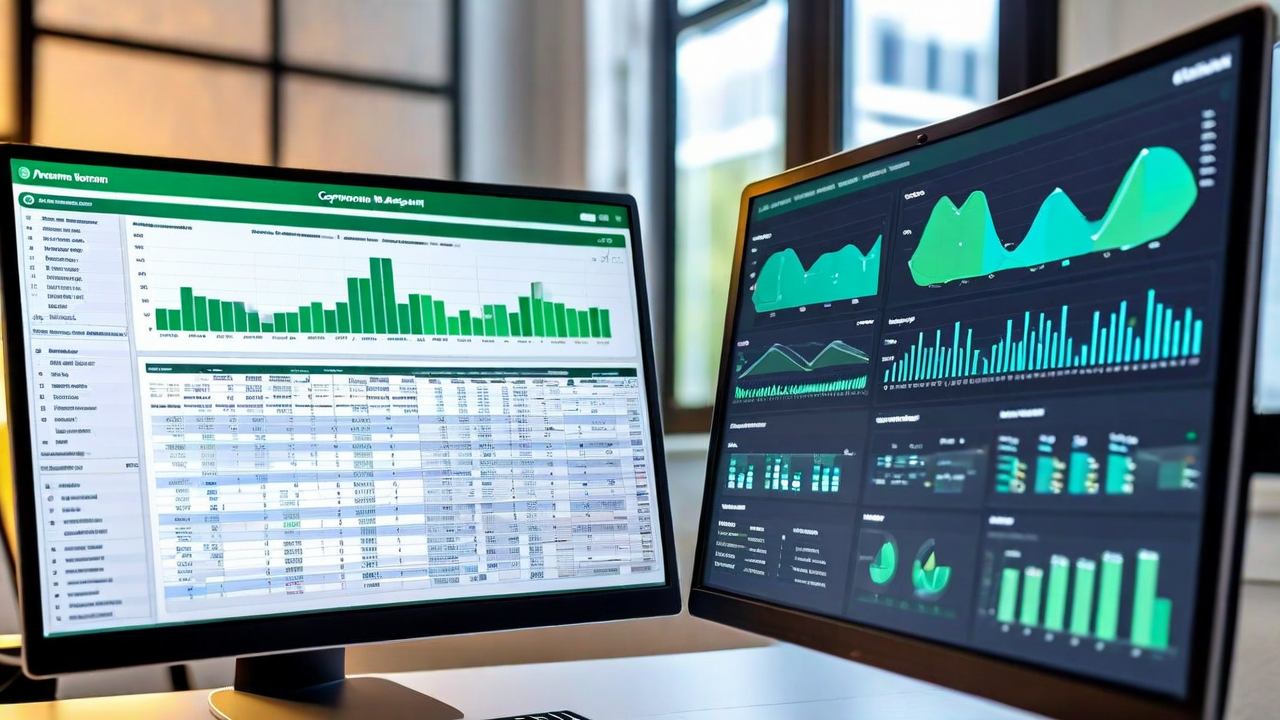
I want to start by saying something most carbon accounting software vendors will not: spreadsheets work. For a company doing its first GHG inventory, with one or two facilities, a handful of emission categories, and a sustainability manager who will personally review every number, a well-built Excel model can produce a defensible GHG inventory. It is not glamorous, but it is not wrong either.
The question is not whether spreadsheets can work. It is whether they work for your organization at your current stage, and whether the risks and costs are worth it compared to purpose-built software. Having set up both, I can walk you through where the lines actually are.
What Spreadsheets Do Well
Flexibility is the genuine advantage. A well-constructed Excel model can be customized to your exact boundary definitions, your chosen emission factors, your organizational structure, and your reporting format. You are not constrained by what a software vendor decided belongs in a dropdown menu. For organizations with unusual operations or complex boundary questions, that flexibility matters.
Spreadsheets are also transparent in a way software rarely is. Every formula is visible. You can trace any output back to its source inputs without relying on documentation that may or may not match what the system actually does. For assurance providers, a transparent spreadsheet model with clear documentation can actually be easier to review than a black-box software platform.
And the cost is real. For a 200-person company doing an annual GHG inventory, the total cost of carbon accounting software — including implementation, training, and annual licensing — can run $30,000 to $80,000 per year. A sustainability analyst who really knows Excel can replicate a significant portion of that functionality for nothing.
Where Spreadsheets Break Down
The problems start when scale or complexity increases faster than the model can keep up with. The first sign is usually version control: you have three versions of the 2024 inventory spreadsheet, each modified by different people, and you are no longer sure which one is the authoritative file. The second sign is data collection: you are emailing 40 facilities to fill in a standardized template, then manually copying their responses into a master spreadsheet, and one facility's numbers are in a different unit than everyone else's. The third sign is audit readiness: an assurance reviewer asks you to show the calculation for a specific emission source and you spend two hours tracing it through nested formula references before finding an error introduced two updates ago.
Each of these problems is manageable once. They become unmanageable when they happen simultaneously across a growing inventory. Companies with 10 or more facilities, Scope 3 data from dozens of suppliers, multiple business units with different emission profiles, and annual assurance requirements are almost universally better served by purpose-built software — not because spreadsheets cannot theoretically handle the complexity, but because maintaining that complexity across multiple reporting cycles is a full-time job that does not scale.
What Carbon Accounting Software Actually Gives You
Purpose-built platforms solve three specific problems that spreadsheets handle poorly: data collection at scale, emission factor management, and audit trail generation.
Data collection: most platforms include supplier and facility portals where data submitters enter their own numbers directly, with validation rules that catch unit errors and outliers before they reach the central inventory. This eliminates a significant chunk of the manual aggregation work and reduces the error rate substantially. One manufacturing client we worked with cut their data collection cycle from 11 weeks to 3 weeks after switching from email-based spreadsheet collection to a platform with facility portals.
Emission factor management: the EPA, IPCC, DEFRA, and other bodies update their emission factors regularly. In a spreadsheet, you have to track those updates manually, update the relevant cells, and document which version of each factor you used in which year. Carbon accounting platforms update factors automatically (or flag when updates are available) and maintain a complete history of which factors were applied to which calculations. For retroactive restatements, this is invaluable.
Audit trails: every good platform generates a complete calculation record — input data, emission factor applied, conversion, result — for every emission source. An assurance reviewer can drill into any line item and see exactly how it was calculated. This is the single biggest driver of reduced assurance costs, and it is nearly impossible to replicate in a spreadsheet without building a documentation system that is almost as much work as the accounting itself.
The Real Decision Criteria
Here is the honest framework for making the call. If you have fewer than five facilities, are not subject to external assurance requirements, have a stable organizational structure, and are reporting to fewer than three frameworks, spreadsheets are probably fine for now. If you have more than 10 facilities, are preparing for or already under assurance, have Scope 3 categories requiring supplier data collection, or are reporting to CSRD and SEC simultaneously, software will pay for itself within one reporting cycle in staff hours alone.
The middle ground — 5 to 10 facilities, voluntary reporting, growing program — is where the decision is genuinely close. In that case, I would weigh whether you are planning to scale, whether you have the internal Excel expertise to maintain a complex model, and whether you anticipate assurance requirements in the next two years. If the answer to any of those is yes, moving to software now saves a painful migration later.
What I would not do: buy carbon accounting software primarily because it makes good-looking dashboards. Aesthetics are not a reason to spend $50,000 per year on a platform. The decision should be driven by data quality, audit readiness, and operational efficiency. If those things matter, the cost is usually justified. If you are at a stage where they do not yet matter, save the budget for something else.
Ready to Move Beyond Spreadsheets?
NetZero Trail is designed for organizations that have outgrown spreadsheet-based carbon accounting. See how the platform handles your specific inventory structure.
Request a Demo